Archive for the ‘Eurovision’ Category

Reviewing Ireland’s 2014 Eurovision Song Contest semi-final draw

January 20, 2014

Adrian Kavanagh, 20th January 2014

The draw for semi-final allocations for this year’s Eurovision Song Contest took place this afternoon in Copenhagen.
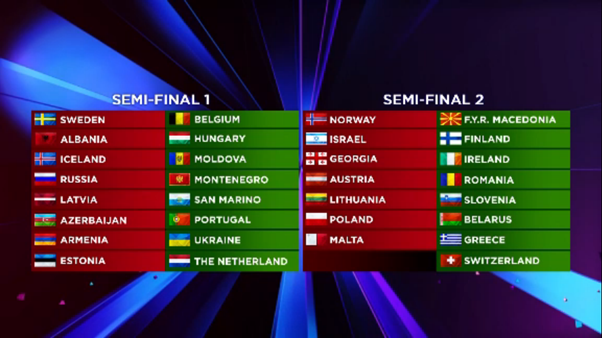
As the picture above shows, Ireland will be taking part in the second of the semi finals (on May 8th 2014). This will be the smaller of the two semi finals, meaning that Ireland has a better chance of qualifying obviously with one less country to beat!

The Big 5/Host countries voting in Ireland’s semi final will be the United Kingdom, Germany and Italy. To get the United Kingdom is excellent news, as they are Ireland’s closest friends statistically when it comes to Eurovision voting. On the other hand, it is bad news to have drawn Italy, as that country has yet to award an Irish act any points at the contest since the Italians returned to Eurovision in 2011. On average, Germany is a rather good draw for Ireland, though it is a pity that the hosts, Denmark, will not be voting in this semi-final, as Denmark has awarded more points to Irish acts, on average, than any other country apart from the United Kingdom since the introduction of the televoting era in 1998.

Looking at the positive aspects of the draw – and comparing this to the wish-list developed out of the analysis in the previous post – Ireland will be happy to be drawn with countries such as Malta, Lithuania, Switzerland, Finland and Norway, as these countries have tended to award higher than average points to Irish entries in the decade-a-half-long history of the televoting/50-50 televoting and jury voting eras. Based on past voting trends, a good Irish act would also be hopeful of taking some points off the Polish, Slovene (especially given that there is only one other former-Yugoslav country in this semi final) and Austrian jury voters/televoters. It is also a positive development, from a competition angle, to have missed all of the “big hitters” from the Post-Soviet pot, with Ukraine, Russia and Azerbaijan (as well as Armenia) being drawn into the other semi final. With Sweden also drawn into Semi Final 1, the only really consistently strong countries/consistent qualifiers in Ireland’s semi final would be Greece, Romania and Norway. In effect, Ireland can have little complaints in terms of the countries that they were drawn to compete against from a number of the pots, but most notably Pots 1, 2 and 3. In Semi Final 1 last year, six Former Soviet states took part and all qualified. This year, seven Former Soviet states will be in Semi Final 1 and only three will be in Semi Final 2, so this is another good reason why Semi Final might well be a pretty good draw for Ireland.

On a negative aspect, Ireland will be sorry to have not got drawn with either Belgium or the Netherlands from Ireland’s own pot, though it is probably a good thing that the Irish also avoided Armenia from this pot. (With so many countries with large Armenian diaspora voting in Semi Final 1, such as France, Belgium and the Netherlands, and with Estonia, Latvia, Russia and the Ukraine also voting in this, this is shaping up as a dream draw for the Armenians!) Statistically, Ireland would also have preferred to have got Hungary and San Marino from Pot 5 instead of Poland and Austria, but a good Irish entry should be hopeful of winning points from the Poles and the Austrians, all the same. Pot 6 was a mixed bag for the Irish; Ireland would have preferred to have drawn Portugal than Romania, but did draw the Maltese and avoid Moldova – so on the law of averages, this could be looked on as a slightly better than average outcome for Ireland in terms of the Pot 6 selections.

On a somewhat more worrying note, if we compare Ireland’s voting record in relation to the countries voting in this semi-final (across the 1998-2013 period) against that of the other fourteen countries that are competing in this, the following result would be predicted for this semi final:

1. Greece 127, 2. Norway 106, 3j. Malta/Romania 97, 5. Israel 75, 6. Lithuania 73, 7j. Georgia/Finland 68, 9. Poland 66, 10. Belarus 58, 11. Ireland 56, 12. Switzerland 44, 13. Austria 43, 14j. FYR Macedonia/Slovenia 33.

This analysis would have Ireland just missing out on being one of the ten countries predicted to qualify from this semi-final, but the margins involved are quite tight and there are relatively few points separating Ireland and the countries just falling inside the Top 10, namely Belarus (2 points), Poland (10 points) and Georgia/Finland (12 points). While the analysis suggests that Greece, Norway, Malta and Romania are relatively safe bets to make it to the final, the same cannot be argued in relation to the countries found in the 4th-10th berths of the predicted Top 10 here!

Based on past voting trends, the type of Irish entries favoured by some of our strongest friends in this draw, namely Switzerland and Norway, tends to be ballad entries, while up-tempo Irish entries have garnered little interest among the Swiss and Norweigian (and also the Israeli) televoters and juries in recent years.

Analysis of the draw for 2014 Eurovision Song Contest semi finals. What countries does Ireland want to be drawn with or avoid?

January 15, 2014

Adrian Kavanagh, 16th January 2013

The draw for the 2014 Eurovision Song Contest semi finals takes place on Monday 20th January in Copenhagen. After this draw, Ireland will know what semi final its act will be taking part in, the countries that will be competing against this act for one of the ten qualifier slots from this semi final and (pretty importantly!) the three Big 5/Host countries that will have the right to vote in this semi final. This post will assess the possibilities facing Ireland ahead of this draw and pinpoint what would be an ideal/nightmare draw for the Irish act.  (more…)

Acts confirmed for the 2014 Eurovision Song Contest

December 31, 2013

Adrian Kavanagh, 31st December 2013

The 2014 Eurovision Song Contest is scheduled to take place in Copenhagen, Denmark, between 6th and 10th May 2014, but with a number of countries withdrawing from the 2014 contest the number of participants could well be the lowest since the semi-final system was introduced in 2004. Cyprus, Croatia, Serbia and Bulgaria are withdrawing from the 2014 contest. However Poland (missing since the 2011 contest) and Portugal (who did not take part last year) are returning, meaning that 37 countries will be taking part in this year’s event. (more…)

Eurovision winners in the UK charts over the past two decades

August 2, 2013

How have Irish Eurovision winners fared in the official UK charts? And how do recent Eurovision winners compare?

Johnny Logan’s Eurovision winners got to No. 1 (What’s Another Year – 1980) and No. 2 (Hold Me Now – 1987) in the UK charts. That record is not too shabby in fairness. Dana also made No.1 in 1970 with “All Kinds of Everything” and actually had five other Top 40 hits in the UK between 1971 and 1976, probably making her one of the most successful Eurovision acts in terms of UK chart performance.

As for the other Irish winners, Linda Martin’s Why Me made No. 59 in 1992 but Niamh Kavanagh got to No. 24 with In Your Eyes the following year (the strongest chart performance of the 1990s winners) while Eimear Quinn made No. 40 with The Voice in 1996. But Paul Harrington and Charlie McGettigan’s Rock and Roll Kids does not seem to have charted.

The last Eurovision winners got to the following positions in the official UK charts: Only Teardrops: No. 15 in 2013, Euphoria: No. 3 in 2012, Running Scared: No. 61 in 2011, Satellite: No. 30 in 2010 and No. 10 in 2009. The 2005, 2007 and 2008 winners do not seem to have charted, though Lordi did get to No. 25 in 2006 and Ruslana got to No. 47 in 2004.

Other notable charting Eurovision winners over the past two decades include Dana International’s 1998 winner Diva which got to No. 11 and Charlotte Nilson’s 1999 winner Take Me To Your Heaven which reached No. 20, as well as Katrina and the Waves’ 1997 winner Love Shine A Light, which peaked at No. 3 in the UK single charts. 

Earlier contest winners have fared somewhat better. Bucks Fizz’s Making Your Mind Up scored a No. 1 hit in 1981, while the following year saw the English version of Nicole’s 1982 winner (A Little Peace) reached No. 1 in the charts. Milk & Honey’s 1979 winner Hallelujah reached No. 5.  Corrine Hermes’ 1983 winner did not chart however, while The Herreys’ Diggi Loo-Diggi Ley only got to No. 46 in 1984 and the following year saw Bobbysocks’ Let It Swing fare only slightly better, reaching No. 44 in the charts.

Some of the other UK Eurovision entries have enjoyed some chart success over the past twenty years, with Scooch’s Flying The Flag For You reaching No. 5 in 2007, Precious’ Say It Again reaching No. 6 in 1999, Love City Groove’s er Love City Groove reaching No. 7 in 1995, Daz Sampson’s Teenage Life reaching No. 8 in 2006, Jessica Garlick’s Come Back reaching No. 12 in 2002, James Fox’s Hold On To Our Love reaching No. 12 in 2004, Jemini’s Cry Baby reaching No. 15 in 2003 and Imaani’s Where Are You attaining the same chart position in 1998 and Sonia’s Better The Devil You Know doing likewise in 1993, Blue’s I Can reaching No. 16 in 2011, Javine’s Touch My Fire reaching No. 18 in 2005, Frances Ruffelle’s Lonely Symphony reaching No. 25 in 1994,  Jade Ewen’s It’s My Time reaching No. 27 in 2009, Lindsay Dracas’ No Dream Impossible reaching No. 32 in 2001, Nicki French’s Don’t Play That Song Again reaching No. 34 in 2000, Engelbert Humperdinck’s Only Love Will Set You Free reaching No. 60 in 2012 and Andy Abraham’s Even If reaching No. 67 in 2008.

But the most successful of these entries – and indeed the most commercially successful Eurovision entry in terms of UK chart success over the past two decades – was Gina G’s Ooh Aah…Just A Little Bit which got to No. 1 in the UK charts in 1996 and remained in the UK charts for 25 weeks.

The most successful Eurovision winner, in terms of UK chart success, of course is ABBA, with nine No. 1’s and ten other Top 10 hits between 1974 and 1982. Though even their record is probably surpassed by Cliff Richard, who would (I think) be the most commercially successful Eurovision act as measured by UK chart position. Though still didn’t help him beat “La La La” in 1968…

Although Celine Dion has probably been one of the most commercially successful Eurovision winners and has attained two No. 1 hits in the UK charts to date, her 1988 Eurovision winner, Ne Partez Pas Sans Moi failed to chart.

Trying to make sense of the Jury/Televote split results of Eurovision 2013

May 29, 2013

Adrian Kavanagh, 29th May 2013

The change in the rules over the manner in which televotes and jury votes are combined in the 50-50 televote/jury vote system to determine the points that a country is giving has mystified many and caused no little controversy in the wake of the 2013 Eurovision Final, with political leaders in countries such as Russia, Belarus and Azerbaijan all expressing concerns on this issue and with Irish people generally bemused at the low one point score for Ryan Dolan from the United Kingdom. (more…)

The real winners of Eurovision 2013 are…well the actual winners, Denmark

May 19, 2013

Adrian Kavanagh, 19th May 2013

Which country would be the winners of this year’s Eurovision Song Contest if past voting history/bloc voting patterns were taken out of the equation? Premised on the fact that certain countries come to Eurovision with some degree of an advantage over others due to be able to rely on consistent support levels from some other Eurovision countries due to friends and neighbours voting and/or diaspora voting, expected votes tallies (irrespective of other factors such as song quality, performance, draw position) were calculated based on what level of support each of the 26 finalists would have received from the 38 other countries voting in last night’s final. (more…)

Which countries voted for Ireland at the 2013 Eurovision?

May 19, 2013

Adrian Kavanagh, 19th May 2013

Ireland finished in 26th place in the 2013 Eurovision Final with 5 points and finished in 8th place in Tuesday night’s Eurovision semi-final with 54 points (8 points ahead of the 11th placed country, Serbia). (more…)

Luck of the draw? Importance of position in the running order at Eurovision finals

May 18, 2013

Adrian Kavanagh, 18th May 2013

A version of this piece appears in The 2013 Eurovision Handbook – this is still available to download in e-book format for the price of €2.99 and proceeds of this will go to the Irish Cancer Society – see:

http://johnnyfallon.wordpress.com/2013/05/09/please-support-eurovision-handbook-in-aid-of-irish-cancer-society/ 

Song and performance matters in terms of ultimate Eurovision success, although “diaspora” and “friends and neighbours” voting can also help a country’s prospects of doing well in the contest – though of course not in themselves proving sufficient to win the contest for those countries that can especially benefit from these voting trends. But another key factor that can shape a country’s hopes of winning the contest is the draw position they get to perform in, with the usual rule of thumb suggesting that a late draw position will significantly help a country’s hopes of doing well in the contest. (more…)

What Eurovision 2013 finalists will get the big points from voting countries tonight?

May 18, 2013

Who are countries likely to give the big points to in tonight’s Final? The table below presents the likely suspects for each of the countries voting tonight in the order that they have been scheduled to present their votes tonight, based on these countries’ patterns of Eurovision Song Contest voting since the introduction of televoting in 1998. This analysis just looks at voting patterns for the 26 countries taking part in tonight’s final and it must be noted that some of the countries listed below would traditionally give higher points levels to other countries that may have been eliminated this year at the semi-final stage (as is very much the case with The Former Yugoslav voting bloc) or to countries that are not taking part in this year’s contest (such as Turkey, Bosnia and Herzegovina, Portugal).

A full outline of the usual voting patterns of all these countries (including losing semi-finalists in this year’s contest and countries that did not take part in 2013) may be viewed in The 2013 Eurovision Handbook, which is still available in e-book format at the price of €2.99 with all profits from this going to the Irish Cancer Society.

http://johnnyfallon.wordpress.com/2013/05/09/please-support-eurovision-handbook-in-aid-of-irish-cancer-society/ (more…)

Eurovision Final prediction: It’s Denmark but only by a teardrop…

May 17, 2013

Adrian Kavanagh, 17th May 2013

As I used this model to successfully predict the Azerbaijan win at the 2011 contest ( https://adriankavanagh.com/2011/05/13/g-oh-oh/ ), now that we know the running order for the 2013 Eurovision Final I am going to use this to tease out who the likely winners will be of the 2013 contest will be.

Those of you who have read The Eurovision Handbook 2013 will know that I used this same model to (sort of!) successfully predict most of the qualifiers for this year’s final: 

http://johnnyfallon.wordpress.com/2013/05/09/please-support-eurovision-handbook-in-aid-of-irish-cancer-society/ ).

With the numbers crunched, pre-contest favourites Denmark sit on the top of the pile, but only by a teardrop. And the figures suggest that Russia, Ukraine, Azerbaijan and Norway would also be very much in the mix to take the ultimate honours, with Greece, Italy, Germany, Georgia and Sweden closely in pursuit.

(more…)