Release of 2011 Eurovision Televote and Jury Vote figures

May 26, 2011

Adrian Kavanagh, 26th May 2011

The EBU has just released jury vote and televote details for the recent Eurovision Song Contest final and two semi finals – almost a month earlier than the 2010 figures were released last year – which throw up some interesting findings as was the case for the 2010 figures. Read the rest of this entry »

Eurovision 2011 – Ireland’s Circle of Friends!

May 17, 2011

Adrian Kavanagh, 17 May 2011

Ireland finished 8th in both the Final and the second Semi Final of Eurovision 2011, winning 119 points from 42 other voting countries (average of 2.8 points) in the Final and 68 points from 21 other voting countries in the semi final (average of 3.2 points) – the slightly higher average vote in the semi final can be explained by the fact that Ireland was competing with 18 other countries for votes in the semi final with the number of countries competing with Ireland for points in the final increasing by 33.3% to 24.  Ireland earned points from 17 different countries (and no points from 25 countries) in the Final, while Ireland earned points from 13 different countries (and no points from 8 countries) in the semi-final.  So who were the countries that were most generous in terms of awarding points to Ireland in this year’s contest? Read the rest of this entry »

Bloc-ed Out? How Eurovision voting blocs voted in 2011

May 16, 2011

Adrian Kavanagh, 16 May 2011

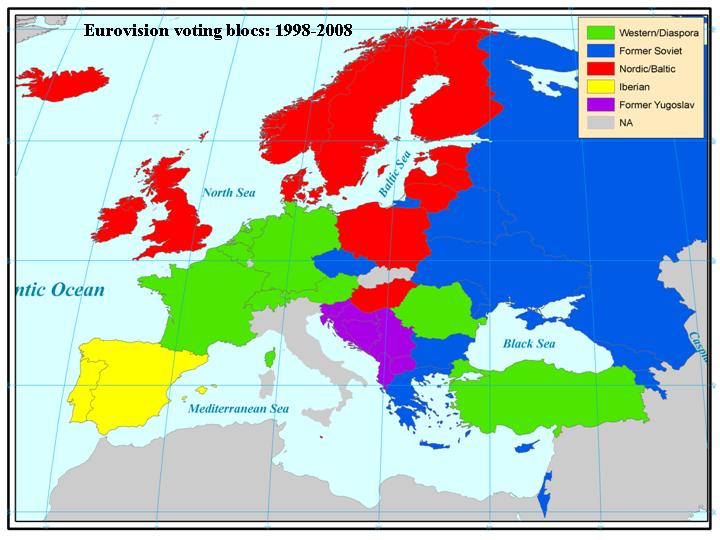
Eurovision televoting blocs

Despite our good result on Saturday night, there has again been some disgruntlement at the impact of what is perceived to be bloc voting, but actually amounts to a combination of geographical (or classic “friends and neighbours”) voting and diaspora voting. Analysis I did on televoting patterns by different Eurovision countries in past contests suggests the existence of different voting blocs that tend to especially favour certain countries in Eurovision contests and from which other bloc members will expect to poll their greatest number of votes by and large. These different blocs – Western European-Diaspora, Former Soviet-Orthodox, Former Yugoslav, Iberian and Nordic – are described in the above map.

So how did these blocs vote in this year’s contest? This post will briefly look at average votes won across different blocs for all the countries competing in last Saturday’s final. Read the rest of this entry »

We are the real winners of Eurovision!!! (Well, sort of…)

May 16, 2011

Adrian Kavanagh, 16th May 2011

Congratulations to Jedward and their team on a great perfromance in Dusseldorf and a great result in taking 8th place for Ireland in the final (and also the semi final, proving earlier point that getting out of the semi final would be as difficult as doing well in the final!) They also won the Artistic Award (voted on by all commentators at the Eurovision) and were thankfully very sedate when they received it…NOT!

In the previous post, I suggested that Azerbaijan would win the contest if based on past voting history and voting patterns of the 43 countries (or rather 42 countries, as Italy could not be included due to returning to the contest this year after a 13 year absence) during the televoting era (1998-2010). Comparing the predicted results based on voting history with the actual results could give us a glimpse of what the actual results might have been once the bloc (or rather, geographical/diaspora) voting dimension was discounted. Read the rest of this entry »

g-Oh Oh, Oh Oh Oh, Oh Oh Oh, Oh Oh…ing To Win Eurovision?

May 13, 2011

Adrian Kavanagh, 13th May 2011

In terms of working out who may win this year’s Eurovision (and hopefully making a few bob in the process) various factors can be looked at, but the three most significant ones are the Eurovision betting odds, past voting histories involving the contestants and the countries voting in the contest, and draw position. Read the rest of this entry »

Thoughts on Jedward’s #6 draw position

May 12, 2011

Adrian Kavanagh, 13th May 2011

There’s no use trying to argue that this is nothing other than a fairly lousy draw, given that acts draw to perform in the earlier stages of Eurovision finals generally tend to do worse than those on later – just as the ate draw worked for us in the semi final this earlier draw can’t help our Eurovision hopes. It is not as bad as the No. 2 draw of course, which fell to the luckless Dino Merlin of Bosnia who had already had to perform at the No. 1 position in Thursday’s semi final, or the No. 3 draw, which would seriously millitate against the Danish hopes. But the Irish draw position becomes worse when you consider that it is towards the start of an uptempo song road-block in the earlier part of the draw, stretching from the No.5 draw position to the No.10 draw position – there is a similar slower tempo/ballad road block in the later part of the draw stretching from the No.18 draw position effectively to the No.23 position (with Spain in No.22 breaking this sequence).

Ireland and 2011 Eurovision Semi Final – Where oh where will the points come from?

May 11, 2011
Adrian Kavanagh, 11 May 2011

It’s the day after the first Eurovision semi final and a number of the stronger countries over the past decade have failed to make it to the final, most notably Armenia and Turkey, but also Norway, Portugal, Albania and Croatia. The die was probably cast for Armenia and Turkey some months back when the semi final draw allocations meant that countries with large Armenian and Turkish diaspora, such as Germany, France, Belgium and the Netherlands, would not be voting in their semi final. So what about Ireland ahead of tonight’s key dress rehearsal (which the juries will be voting on) and tomorrow night’s show ? The draw augurs poorly for us in that some of our stronger supporters in Eurovision over the past decade and a half – most notably our good neighbours, the UK, but also countries such as Turkey, Hungary, Lithuania, Norway and Switzerland – will not get the chance to cast votes for us in this semi final. So where oh where can we hope to pick up points? In this post I will look at the likelihood of winning points from each of the 21 other countries that will be voting in our semi final – the other semi finalists and also the three “Big 5” countries allocated a vote for this semi final. I will solely focus on voting patterns since the introduction of “full-blown” televoting in 1998. Read the rest of this entry »

Paddy Power’s 31st Dail

February 8, 2011

Adrian Kavanagh, 8th February 2011

There’s various predictions being made as to how the seats will break down in the next (31st) Dail, some of which include the December 2010 Newstalk local prediction survey and others involving predictions being made on the basis of constituency-level estimates based on national poll figures, as may be viewed in my politicalreform.ie posts. But one other way of getting a sense as to what the next Dail may look like is to look at the odds being offered by different bookies in terms of who is being predicted to win seats in the different constituencies. Read the rest of this entry »

General Election 2011: Constituency Reviews and Predictions (Updated)

February 7, 2011

Adrian Kavanagh, 24th February 2011

In the version of this post that was finalised in the middle of last week I was estimating Fine Gael seat levels in the mid-60s, with Fianna Fail in the mid-30s. In light of poll trends in the past few days, which in fairness have more or less replicated the trends over previous weeks, and Fine Gael’s continued strong standing/Fianna Fail’s inability to gain any ground over these weeks, in addition to the slight slippage of support by Sinn Fein and Labour’s declining fortunes, and taking into account the fact that Sinn Fein/Labour/the United Left Alliance candidates seat prospects may (especially in Dublin) be hampered somewhat by lower turnouts amongst the younger age cohorts and in working class areas,  I would now call the election results by constituency as follows: Read the rest of this entry »

Voter turnout in the 2007 General Election: A Geographical Perspective

September 30, 2010

 The 2007 General Election marked a notable break from the trend set in the previous quarter of a century of continually declining voter turnout levels in Irish general elections. The percentage turnout level increased by almost 5% to a level of 67.0% relative to the record low of 62.6% for the 2002 contest, while the actual numbers turning out to vote increase by over 200,000 from 1,878,609 in 2002 to 2,084,035.  Read the rest of this entry »